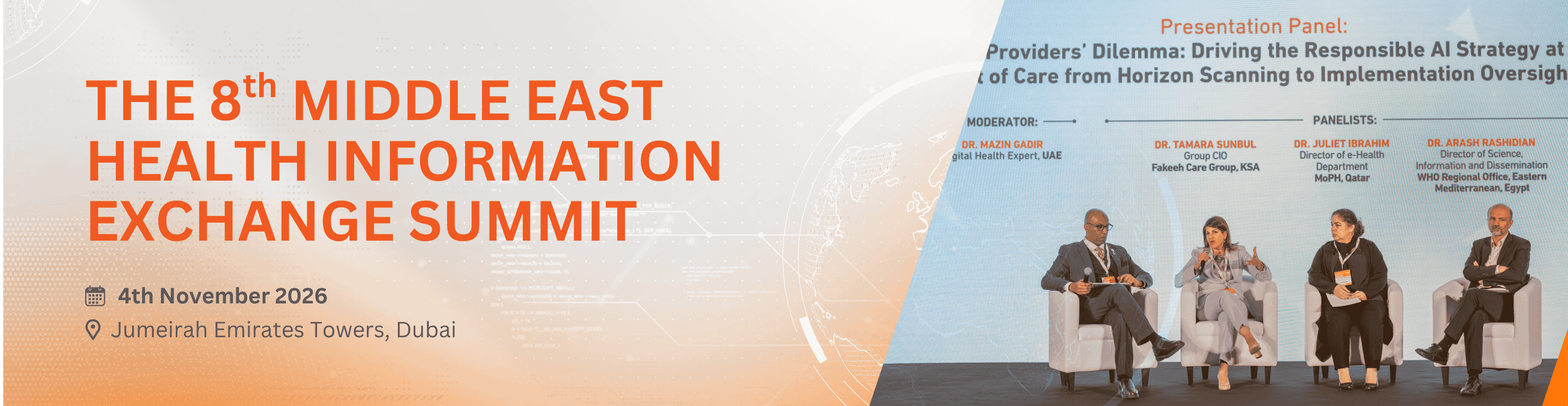
Health Information Exchange (HIE) platforms have spent two decades proving the case for connected care. They have demonstrated that when clinical data travels safely across organizational boundaries, patients receive safer, better coordinated, and less duplicative care. That case is now proven. The question facing the HIE community in 2026 is no longer whether to exchange data, it is whether exchange platforms are ambitious enough in their design, their governance, and their financing to serve as genuine public infrastructure for health system transformation.
This Summit convenes under a deliberate provocation: the transition from Health Information Exchange to Health Data Utility. Where HIE facilitates the movement of clinical data between connected providers, a Health Data Utility (HDU) aggregates, standardizes, and governs data from multiple sectors: clinical care, public health, social services, and community-based organizations and makes that enriched, high-quality data available as a platform for analytics, policy, and population-level intervention. The shift is not merely technical. It is a governance transformation, a financing transformation, and above all a workforce transformation and it cannot happen without all three simultaneously.
The Summit's overarching argument is this: HIE platforms that remain transactional infrastructure moving patient information between providers — will face diminishing strategic relevance as clinical data exchange becomes a commodity embedded in EHR platforms and national frameworks. The platforms that will matter in 2030 are those that have made the deliberate, investment-backed transition to data utilities: authoritative, trusted, semantically precise repositories of whole-person health data that power value-based care contracting, social care integration, AI model training, and population health management at scale.
Four preconditions make this transition possible, and they form the structural pillars of this Summit namely, Semantic Interoperability, Trusted Data (in terms of quality and completion), and the partnership architecture that makes scale financially and organizationally sustainable.
1. SEMANTIC INTEROPERABILITY AND TERMINOLOGY SERVICES
- LO 1.1 - Distinguish the four levels of health data interoperability and articulate why Semantic interoperability is the critical unmet requirement for the HIE-to-HDU transition.
- LO 1.2 - Design a terminology services architecture that sustains semantic consistency across a multi-facility, multi-payer HIE environment.
- LO 1.3 - Apply new advancements in interoperability e.g. FHIR R4 genomics profiles, CDS Hooks, and openEHR archetypes as the technical bridge between semantically structured HIE data and clinical decision support systems.
2. DATA STANDARDS, DATA QUALITY AND PATIENT IDENTITY RESOLUTION
- LO 2.1 - Evaluate the financial and clinical costs of poor data quality in HIE environments and apply a data quality measurement framework aligned with recognized standards.
- LO 2.2 - Compare probabilistic, deterministic, and referential patient matching methodologies and design an improvement roadmap for HIE master patient index (MPI) performance.
- LO 2.3 - Design an interoperability testing laboratory framework that enables and disseminates across the ecosystem continuous national data dictionary development and maintenance, data quality validation, matching algorithm benchmarking, and standards conformance testing especially for advanced terminologies such as LOINC and SNOMED-CT across a regional and national HIE network.
3. VALUE-BASED CARE AND POPULATION HEALTH ANALYTICS
- LO 3.1 - Map the data infrastructure requirements of value-based care contracting models and assess which HIE capabilities are prerequisites for participation.
- LO 3.2 - Apply PORMS and PREMS constructs such as ICHOM Standard Sets as an outcome measurement framework for HIE-enabled value-based care programs, and design an AQL-based reporting pipeline that joins clinical data with patient-reported outcome measures.
4. SOCIAL CARE INTEGRATION, SOCIAL DETERMINANTS OF HEALTH & SUSTAINABILITY
- LO 4.1- Design a data architecture for integrating social determinants of health (SDOH) data into HIE platforms, addressing the technical, governance, and consent challenges specific to cross-sector data exchange.
- LO 4.2 - Evaluate the HDU model as the enabling infrastructure for whole-person health data integration, and design a governance framework for a multi-sector health data utility that incorporates clinical, social, behavioral, and demographic data streams.
- LO 4.2 - Construct a multi-stakeholder partnership model for the HIE-to-HDU transition,mapping the roles, incentives, and governance structures of each partner category.
- LO 5.3 - Develop a sustainable financing model for an HDU, evaluating the relative contributions of public investment, participation fees, analytics service revenue research data access fees, and philanthropic capital.